What the study evaluated
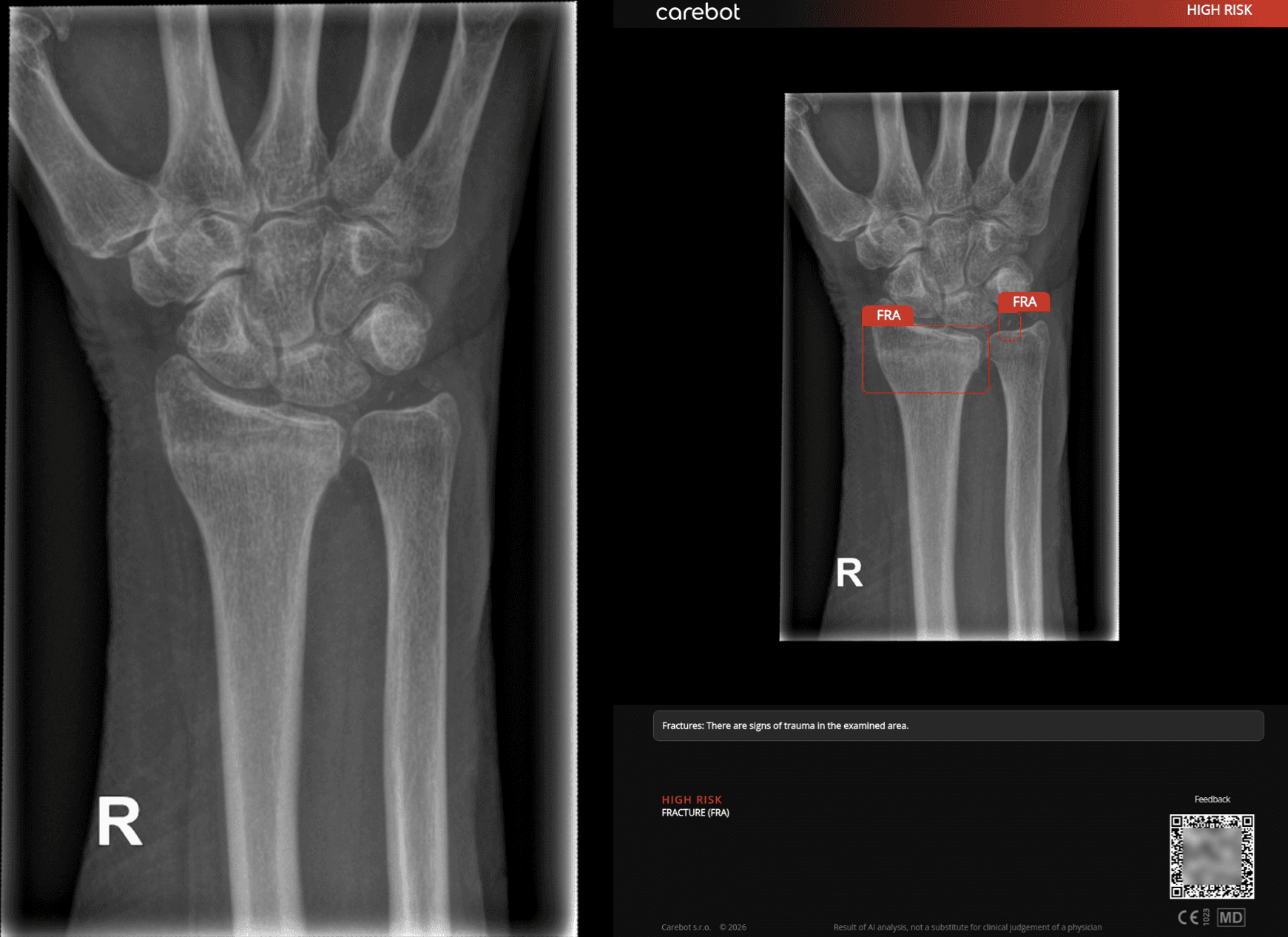
The study evaluated whether Carebot AI Bones improves clinicians’ ability to detect fractures on musculoskeletal X-rays.
A total of 726 radiographs from five Czech hospitals were interpreted twice by seven clinicians. In the first reading stage, clinicians interpreted the images without AI. After a 30-day washout period, they interpreted the same cases again with AI decision support.
The primary analysis used 630 radiographs where the expert trauma surgeon and expert radiologist agreed on fracture presence or absence. This set included 197 fracture-positive and 433 fracture-negative radiographs.
Study results in clinical practice
AI-assisted reading was associated with a clear reduction in missed fractures. Overall sensitivity increased from 86.26% without AI to 94.56% with AI, while the number of missed fractures decreased from 190 to 75 across all reader-case assessments.
This improvement came with a modest trade-off in specificity, which decreased from 93.79% to 90.21%, reflecting more false-positive fracture calls. The effect varied by reader, with the largest improvement observed in the reader who had the lowest baseline sensitivity.
In practice, these findings support Carebot AI Bones as a second-reader decision-support tool. Positive AI suggestions should be treated as prompts for careful re-review rather than as definitive diagnoses.
Key numbers
Primary analysis set: 630 radiographs
Readers: 7 clinicians
Hospitals: 5 Czech hospitals
Study design: multi-reader crossover with 30-day washout
Sensitivity change: +8.30 percentage points, p < 0.001
Specificity change: -3.58 percentage points, p = 0.035
Missed fractures: reduced from 190 to 75
Largest reader-level sensitivity gain: 50.76% to 90.36%
Abstract
Missed fractures on musculoskeletal radiographs remain an important diagnostic problem, particularly in acute and high-volume clinical settings. This multicentre crossover study evaluated whether Carebot AI Bones can improve clinician performance in fracture detection. The study included 726 musculoskeletal radiographs from five Czech hospitals. Seven clinicians interpreted all radiographs twice: first without AI and then, after a 30-day washout period, with AI decision support. The primary analysis was performed on 630 radiographs with expert-agreement ground truth, including 197 fracture-positive and 433 fracture-negative cases. AI-assisted interpretation increased overall sensitivity from 86.26% to 94.56%, corresponding to an improvement of 8.30 percentage points. The number of missed fractures decreased from 190 without AI to 75 with AI. Specificity decreased from 93.79% to 90.21%, indicating a reader-dependent increase in false-positive fracture calls. The negative likelihood ratio improved from 0.15 to 0.06, supporting stronger rule-out performance with AI assistance. Sensitivity increased in six of seven readers, with the largest benefit observed in the reader with the lowest baseline sensitivity. These findings support Carebot AI Bones as a second-reader decision-support tool that may help reduce missed fractures, while AI-positive findings should remain subject to clinician verification.