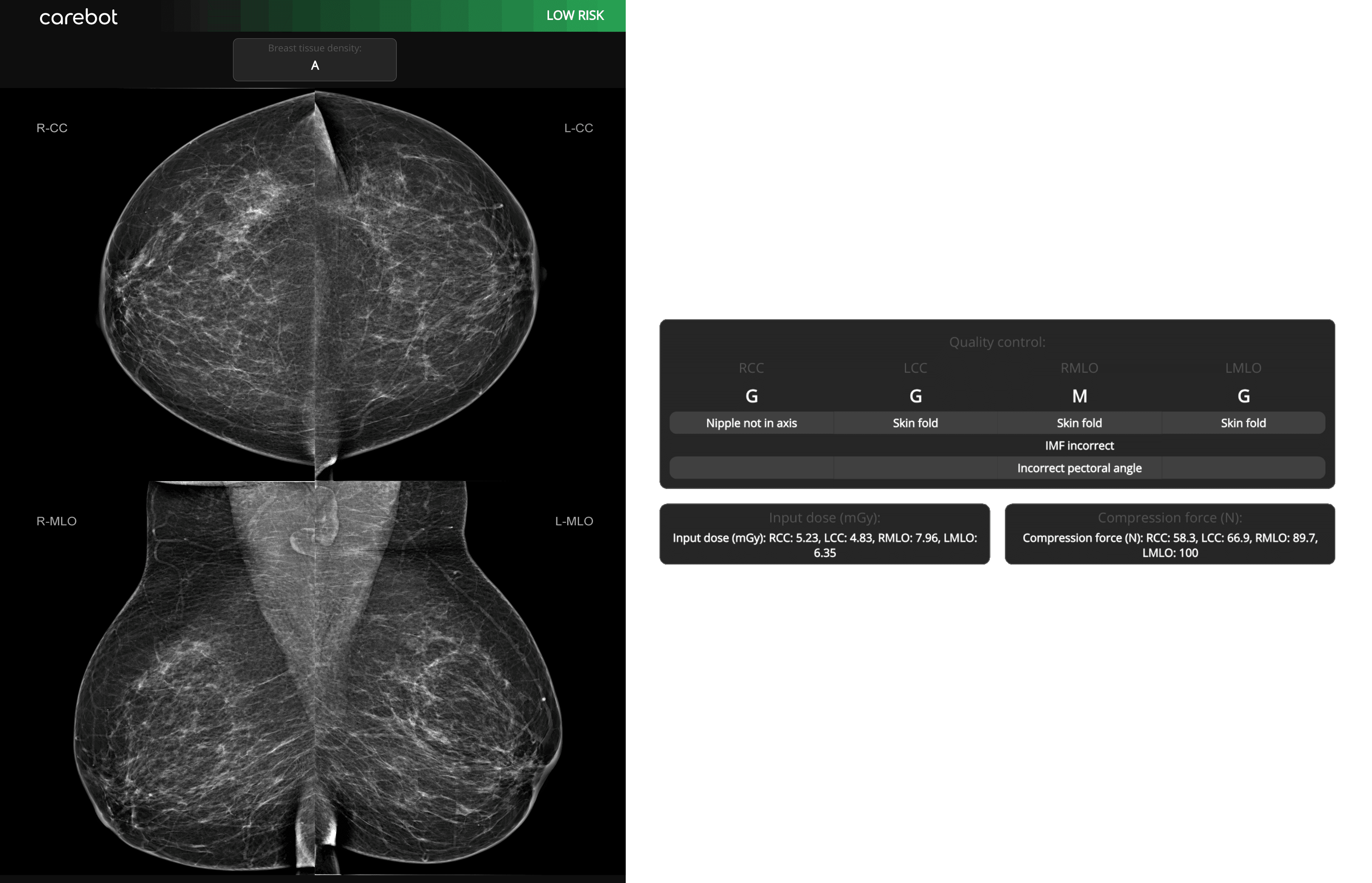
What the study evaluated
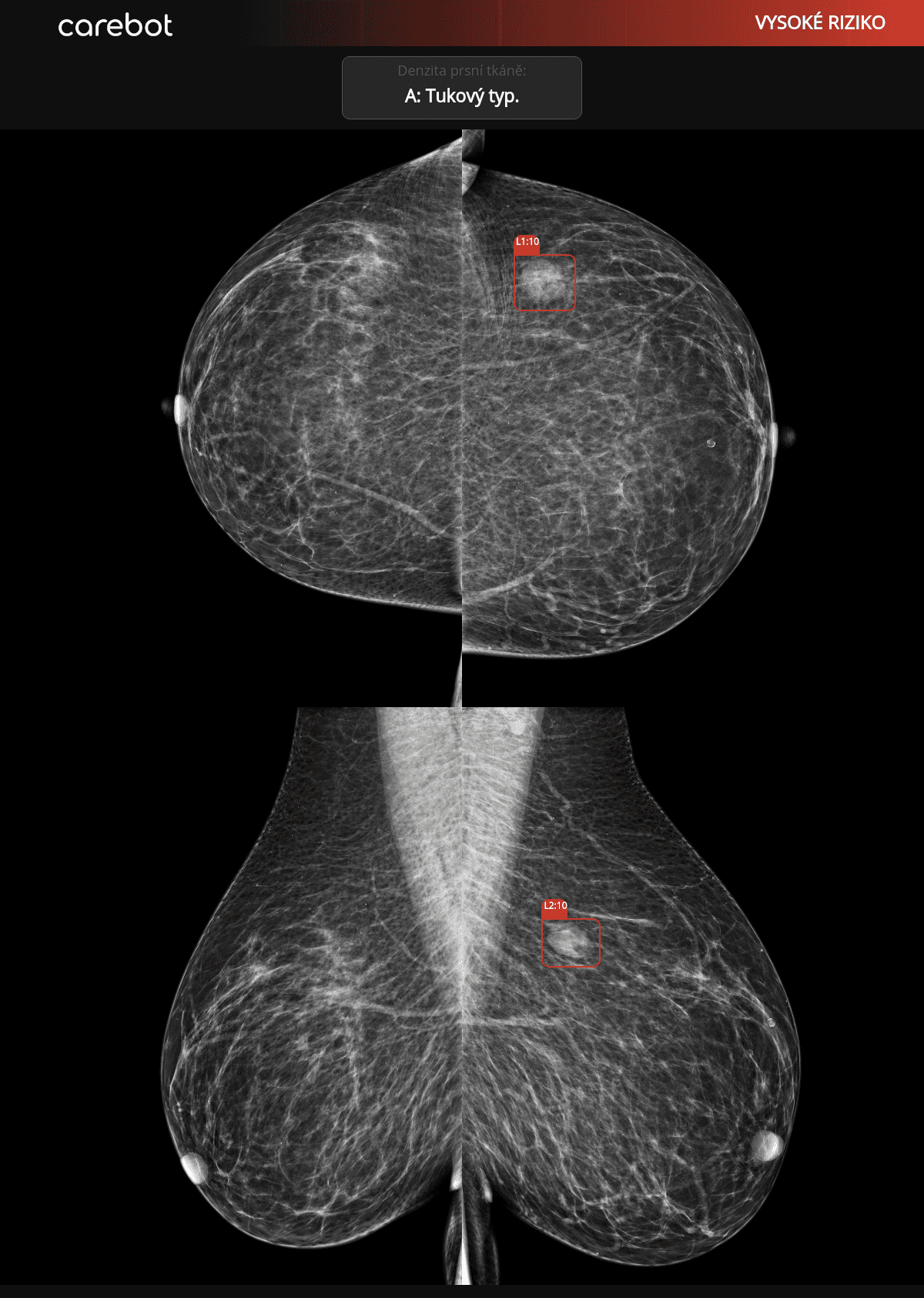
The study evaluated the QA module, designed to assess mammography positioning and technical image quality.
The module assigns image-level PGMI categories: Perfect, Good, Moderate, and Inadequate. For the primary analysis, Perfect and Good were grouped as PG, representing diagnostically acceptable image quality, while Moderate and Inadequate were grouped as MI, representing borderline or unacceptable image quality.
The validation dataset included 60 complete mammography studies, corresponding to 240 images from six hospitals in three countries. Reference PGMI labels and defect annotations were assigned by an experienced breast radiologist.
Study results in clinical practice
Carebot AI MMG showed promising performance for distinguishing diagnostically acceptable mammography images from images that may require review due to positioning or technical quality issues.
For the main binary PG versus MI endpoint, the module achieved 87.92% accuracy, with similar performance for acceptable and borderline or unacceptable images. Direct four-class PGMI classification was more challenging, with accuracy of 69.58%, reflecting the subjective and gradual nature of PGMI grading, especially at boundaries such as Perfect versus Good or Good versus Moderate.
In practice, this supports the use of automated QA as a decision-support tool for acquisition-quality triage. Defect-level feedback may help radiographers identify images that should be reviewed before the patient leaves the imaging unit and may support local quality monitoring and targeted training.
Key numbers
Images analyzed: 240
Hospitals: 6 hospitals in 3 countries
Reference standard: experienced breast radiologist
Binary PG vs MI accuracy: 87.92%
Abstract
Technical quality in mammography depends on consistent positioning, adequate breast-tissue inclusion, appropriate exposure, and absence of relevant artefacts. PGMI grading is used for mammography image-quality assurance, but it includes qualitative judgement and may vary between readers. This retrospective multicentre study evaluated an automated mammography quality-assurance module, Carebot AI MMG version 2.10, for distinguishing diagnostically acceptable image quality from borderline or unacceptable image quality. The validation set included 60 complete mammography studies, corresponding to 240 images from six hospitals in three countries. Reference PGMI labels and defect annotations were assigned by an experienced breast radiologist. For binary classification, Perfect and Good images were grouped as PG, and Moderate and Inadequate images were grouped as MI. The module achieved sensitivity 88.49%, specificity 87.13%, accuracy 87.92%, and balanced accuracy 87.81% for the PG versus MI endpoint. Direct four-class PGMI accuracy was 69.58%. The results support the technical feasibility of automated mammography acquisition-quality triage. The QA module may help standardize immediate image-quality feedback and support radiographer review, local quality monitoring, and targeted quality-improvement workflows. Further prospective studies with multiple reference readers and workflow-impact endpoints are needed to determine its effect in routine mammography practice.