What the study evaluated
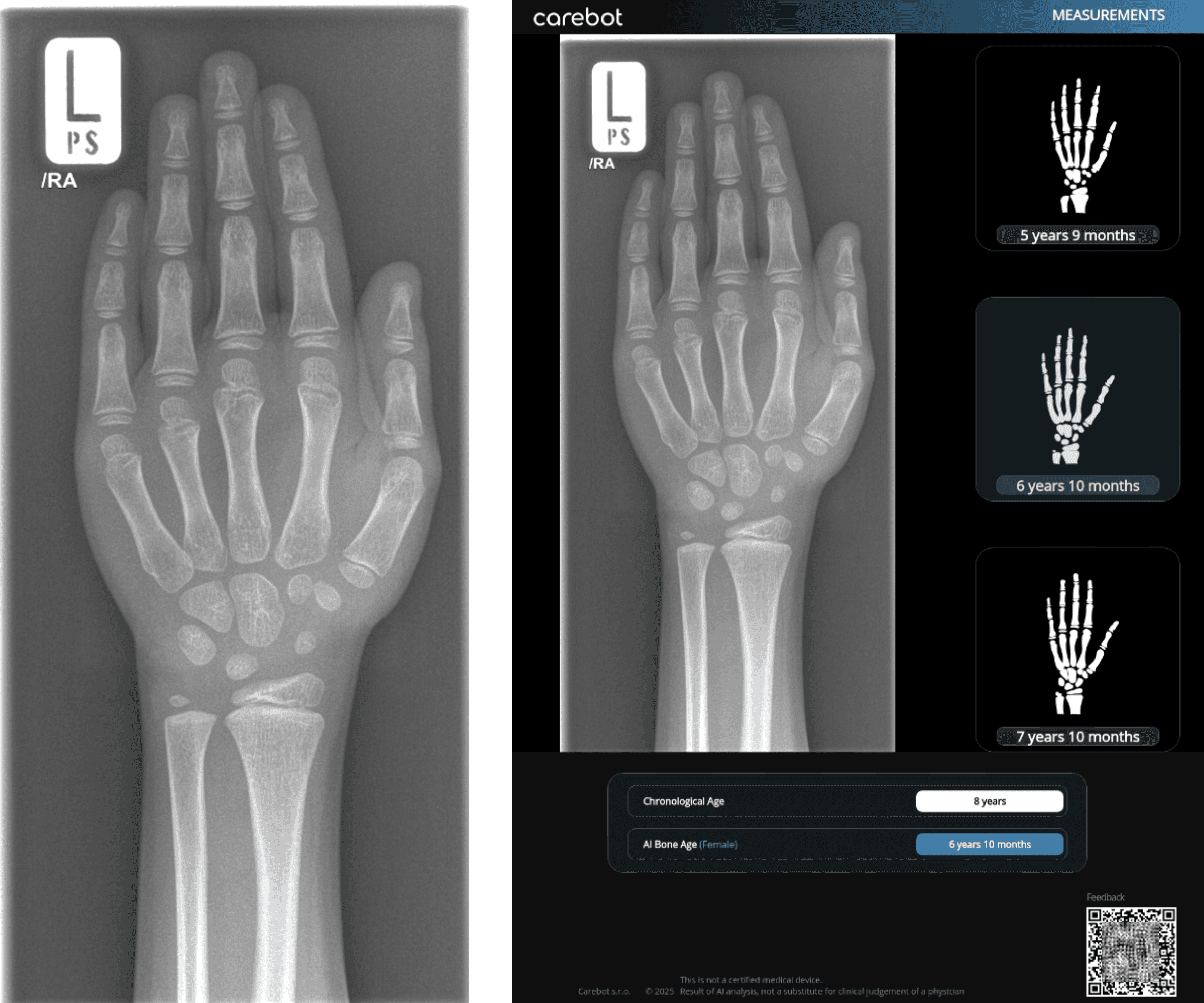
The study evaluated whether Carebot AI Bones, Bone Age function, can automatically estimate bone age from paediatric dorsopalmar hand and wrist X-rays.
A total of 96 anonymized paediatric radiographs from University Hospital Olomouc were analyzed. The reference standard was established using the Greulich-Pyle atlas, with independent assessment by a radiologist and a physical anthropologist, followed by consensus in case of disagreement.
Study results in clinical practice
Carebot AI Bones showed strong agreement with the expert Greulich-Pyle reference standard. The average error was 5.97 months, which is well below the predefined clinical acceptability threshold of 12 months.
In practice, this suggests that automated bone age assessment can support paediatric radiology and endocrinology by providing a fast, consistent second-reader estimate. This may help standardize reporting, reduce manual workload, and support clinical decision-making in children evaluated for growth or endocrine disorders.
Key numbers
Study cohort: 96 paediatric hand/wrist X-rays
Reference standard: Greulich-Pyle consensus by radiologist and anthropologist
Mean absolute error: 5.97 months
RMSE: 8.70 months
Bias: -0.27 months
Correlation with reference standard: Pearson r = 0.981
Predictions within ±6 months: 66.7%
Predictions within ±12 months: 82.3%
Predictions within ±24 months: 96.9%
Non-inferiority threshold: 12 months, met with p < 0.001
Abstract
Bone age is a radiological marker of skeletal maturity used in paediatric radiology and endocrinology to evaluate growth, support diagnosis of endocrine or chronic disorders, and guide clinical management. This retrospective study evaluated Carebot AI Bones, Bone Age function, for automated bone age assessment on 96 anonymized paediatric dorsopalmar hand/wrist radiographs acquired at University Hospital Olomouc between January and June 2025. The reference standard was established using the Greulich-Pyle atlas, with independent readings by a radiologist and a physical anthropologist and consensus adjudication in case of disagreement. The AI algorithm provided a continuous bone age estimate in months. The AI algorithm showed strong agreement with the reference standard, achieving a Pearson correlation of r = 0.981. The mean absolute error was 5.97 months, RMSE was 8.70 months, and mean bias was -0.27 months, indicating minimal systematic deviation. Predictions were within ±6 months in 66.7%, ±12 months in 82.3%, and ±24 months in 96.9% of cases. The predefined non-inferiority criterion of a mean absolute error below 12 months was met. These results support the use of Carebot AI Bones as a second-reader decision-support tool for automated bone age assessment in paediatric hand radiographs.